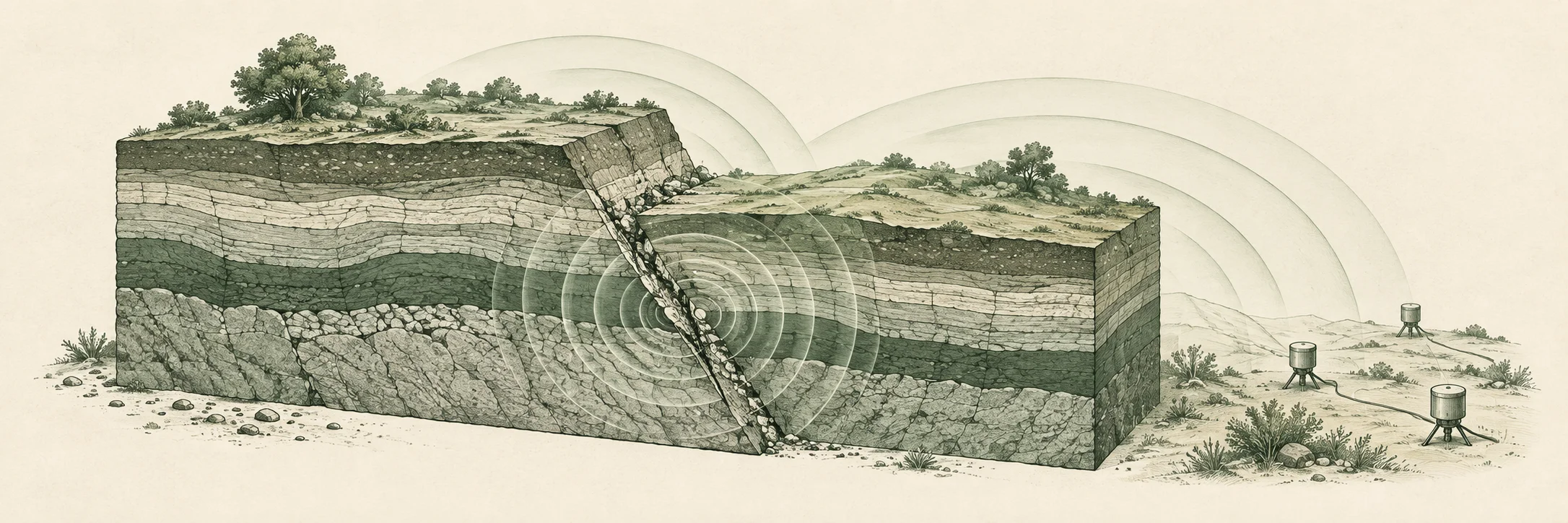
For the First Time, Cameras Filmed the Ground Tearing Open in an Earthquake
For the first time, researchers recorded high-speed video of the Earth's surface splitting apart during an earthquake. It's more than dramatic footage. It's data we've never had before.
· ~4 min read
The breakdown
What Happened
On August 10, 2025, a research team captured something that's never been recorded before: high-speed video of the Earth's surface visibly splitting apart along a fault line during a powerful earthquake. High-speed cameras paired with ground sensors recorded the actual moment of seismic rupture: the crust tearing open in real time.
We've modeled earthquakes computationally for decades. We've studied fault zones after the fact. We've measured seismic waves with incredible precision. But actually seeing the ground tear open as it happens? That's new.
Why This Matters
Earthquake prediction is one of the oldest problems in geoscience, and we're still bad at it. Most of our models are built on indirect evidence: seismic wave data, GPS measurements, historical patterns. We've never been able to directly observe the physical mechanics of how a fault actually ruptures. Theories about how energy propagates, how fractures initiate and spread, how far and fast a rupture travels have been educated guesses backed by indirect measurements.
This footage changes that. Seeing a rupture happen gives researchers direct observational data on fracture velocity, surface displacement, and energy release that computational models can now be tested against. That matters for earthquake prediction models, early-warning systems, and structural engineering in seismic zones. If we can understand how ruptures evolve, we can build models that predict them better, and even a few seconds of improved warning time saves lives in an earthquake.
My Take
This is one of those findings that's cool on its own terms and also practically important. Geoscience isn't my main area, but I work with models and data enough to appreciate what it means to get a direct observation after decades of relying on inference. It's like finally being able to see what a black hole looks like after 50 years of radio telescope data. This is the Event Horizon Telescope moment for seismology.
This is the Event Horizon Telescope moment for seismology.
The real impact will come from what researchers do with this data over the next few years. If the footage confirms existing models, great. If it contradicts them, even better. That's how science moves forward. Either way, we now have a ground truth to calibrate against, and that's been missing from earthquake science for a long time.
Get the next breakdown
Subscribe for one email per issue — methods, limits, and what it actually means.
Related breakdowns
September 2025
Scientists Turned Skin Cells Into Embryo-Like Structures, and Healthy Mice Were Born
Scientists created embryos from ordinary skin cells. The science is real, but the ethical questions are just getting started.
Read breakdown →
January 2026
Biotech Can Now Insert Up to a Million DNA Letters. The Hard Part Is Getting It to Patients
2025 was not just another productive year for biotech. Multiple technologies reached new levels of practical impact. Here is what comes next.
Read breakdown →