Scientists Turned Skin Cells Into Embryo-Like Structures, and Healthy Mice Were Born
Scientists created embryos from ordinary skin cells. The science is real, but the ethical questions are just getting started.
· ~7 min read
The breakdown
The Breakthrough
Scientists have done something that sounds like science fiction: they created embryos from regular skin cells. Not cloned, but built. This is a different process entirely, and it opens doors that reproductive biology wasn't sure were even there.
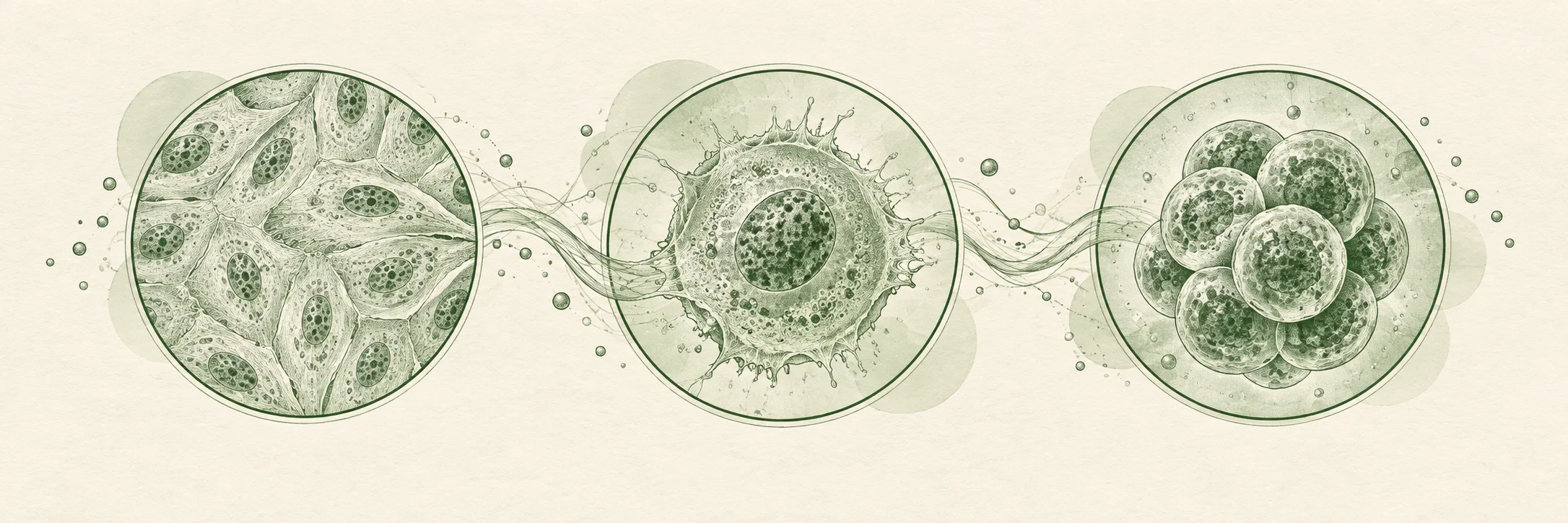
The starting point is ordinary skin cells. Using a combination of chemical signals and genetic reprogramming, scientists convert them into induced pluripotent stem cells (iPSCs), cells that can become any type of cell in the body. From there, they guide these stem cells to form blastoids: tiny embryo-like structures that look and behave like natural embryos in their earliest stages.
In the lab, these blastoids can attach to uterine tissue and start developing like normal embryos would. Scientists have already produced live, healthy mice using this method. The technology works. The question is what happens when we try it in humans, and whether we should.
Why It Matters
The most immediate application is fertility. Couples who can't have children, whether because of infertility, cancer treatment, or genetic conditions, might be able to have biological children using this approach. Same-sex couples could theoretically have children biologically related to both partners. That's a big deal for a lot of people.
On the research side, this gives scientists a way to study early human development without using actual human embryos, which has been a major ethical and legal roadblock. If we can understand how embryos develop in those first critical days, we can learn about what causes birth defects, chromosomal abnormalities, and early pregnancy loss, things we've barely been able to study because we can't experiment on real embryos.
The Gaps
The success rate is low. Most attempts fail. Natural embryos get specific epigenetic markers from both parents, chemical instructions that tell genes when to turn on and off. Blastoids made from skin cells don't have these normal imprinting patterns, and we don't fully understand what problems that could cause downstream.
We're bypassing it entirely and hoping the blastoid figures it out.
The legal landscape is messy. Different countries have different rules about whether synthetic embryos count as real embryos, when they deserve protection, and what kinds of research are permitted. In the US, there's no federal framework specifically addressing this. That gap slows down responsible research and creates uncertainty about what's actually allowed.
Safety is the biggest concern. Modifying cells at this level carries real risks: birth defects, cancer risks, health problems that might not show up for years. Human trials are still a long way off, and for good reason.
My Take
I think the science here is genuinely impressive, and the potential for helping infertile couples is real. But I'm not convinced we're thinking hard enough about the implications. "Creating embryos from skin cells" is a phrase that should make anyone pause, not because it's wrong, but because the gap between "we can do this in mice" and "this is safe for humans" is enormous.
"Creating embryos from skin cells" is a phrase that should make anyone pause.
The imprinting problem is the one that worries me most. Epigenetic programming in natural embryos is a precise, evolved process. We're bypassing it entirely and hoping the blastoid figures it out. That might work. It also might produce subtle developmental issues that don't show up until the child is years old. We won't know until we try, and that's exactly why this needs to move slowly.
As someone who works in genomics, I'm excited about the research applications; studying early development without using real embryos is a huge practical and ethical win. But the clinical applications need way more caution than the headlines suggest.
Get the next breakdown
Subscribe for one email per issue — methods, limits, and what it actually means.
Related breakdowns
September 2025
A New Way to Get Gene Editors Into Cells Tripled Delivery in the Lab
The hardest part of gene editing isn't the editing; it's getting the tools into the right cells. A new method triples efficiency.
Read breakdown →
May 2025
The First FDA-Approved Gene-Editing Therapy Is Here. It Costs Over $2 Million
CRISPR therapies are now editing genes in real patients. The FDA approved the first one. What actually changes and what doesn't.
Read breakdown →