A Breakthrough in CRISPR Delivery
The hardest part of gene editing isn't the editing; it's getting the tools into the right cells. A new method triples efficiency.
· ~5 min read
The breakdown
The Problem
CRISPR-Cas9 can cut and modify DNA with precision. That part works. What doesn't work well enough is delivery: getting the editing machinery into the right cells, at the right time, without triggering an immune response or damaging tissue along the way. Viral vectors (like AAV) are the current standard, but they have cargo size limits, can't be re-dosed easily, and sometimes provoke immune reactions. Non-viral options exist, but they've been less efficient.
That's why newly published research from Northwestern University caught my attention. The researchers combined two existing delivery technologies, lipid nanoparticles (LNPs) and spherical nucleic acids (SNAs), into a single system that delivers CRISPR components more effectively than either method alone.
The Method
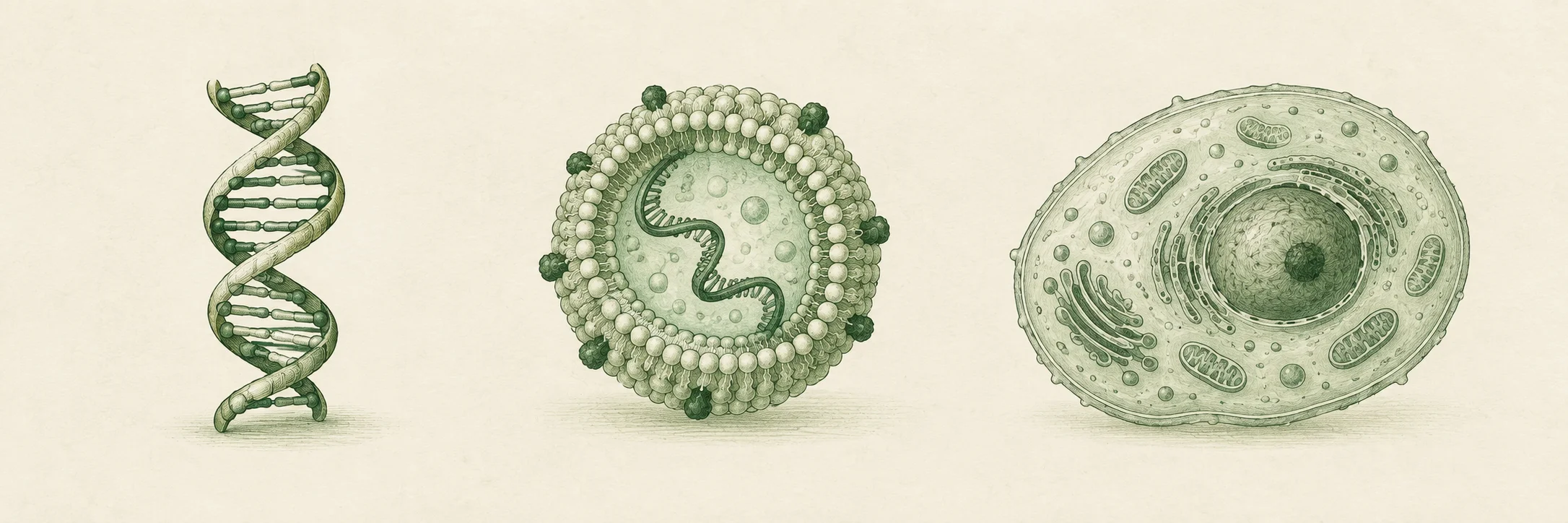
LNPs are already used in mRNA vaccines. They're lipid shells that encapsulate genetic material and fuse with cell membranes to deliver their payload. SNAs are different: they're spherical structures where nucleic acids are densely arranged around a nanoparticle core. This dense arrangement gives them unique properties for getting into cells and protecting their cargo from degradation.
The Northwestern team essentially put CRISPR components inside an SNA structure, then wrapped that inside an LNP. The LNP gets the package to the cell. The SNA structure then helps the CRISPR machinery get into the cell nucleus more efficiently and protects it from being broken down before it can do its job.
In their lab studies, the results were clear: the combined system delivered CRISPR about three times more effectively than conventional methods. Precise DNA repair rates improved by over 60%. Off-target effects decreased because the system protects the editing components better, giving them less time to cause collateral damage.
Why It Matters
Three times more effective doesn't sound dramatic until you realize that delivery efficiency is the bottleneck holding back most CRISPR therapies. A gene editing tool that works perfectly in a petri dish but can't reach the right cells in a living body is basically useless as a treatment. Every percentage point of delivery efficiency gained translates directly into more cells edited, fewer doses needed, and lower risk of side effects.
A gene editing tool that works perfectly in a petri dish but can't reach the right cells in a living body is basically useless as a treatment.
The 60% improvement in precise repair is the number I care about most. CRISPR's biggest safety concern has always been that it might cut in the wrong place or that the cell's repair machinery might fix the cut incorrectly. A delivery method that both gets more editing tools to the right location and reduces off-target activity changes the safety calculus significantly.
My Take
I like this work because it treats delivery as an engineering problem, not a biology problem. Instead of trying to redesign CRISPR itself, they combined two delivery vehicles that each solve part of the challenge. It's a pragmatic approach, and in gene therapy, pragmatic approaches tend to work better than elegant ones.
The catch is that this is still in vitro work. Lab studies with cell cultures are a necessary first step, but a lot of delivery methods that look promising in petri dishes fail in living organisms. The immune system is hard to predict. Tissue penetration is hard to predict. I want to see this in animal models before I get excited.
Also worth noting: LNP + SNA is more complex to manufacture than either one alone. If this scales, it needs to be producible at therapeutic quantities, and that's not trivial for a dual-component system. The science is solid. The manufacturing challenge is real.
The science is solid. The manufacturing challenge is real.
Get the next breakdown
Subscribe for one email per issue — methods, limits, and what it actually means.
Related breakdowns
January 2026
Biotech 2026: What Comes After a Breakthrough Year
2025 was not just another productive year for biotech. Multiple technologies reached new levels of practical impact. Here is what comes next.
Read breakdown →
May 2025
Gene Fix: Biotech's Quiet Revolution in Human DNA
CRISPR therapies are now editing genes in real patients. The FDA approved the first one. What actually changes and what doesn't.
Read breakdown →