Modeling Lab Bias Sharpens the Search for Overlooked Reading Frames
Cells read short stretches of genetic code that gene lists leave out, and the lab method used to find them can smear its own signal. A new tool, RiboBA, models that smearing instead of ignoring it.
· ~5 min read
The breakdown
A gene list is a map of where cells make proteins. Maps like this are incomplete. Cells also read short stretches of genetic code that nobody listed, and some may make tiny proteins. A Nucleic Acids Research study from October 2026 asks how to find those stretches when the lab method itself distorts the evidence.1
The gap
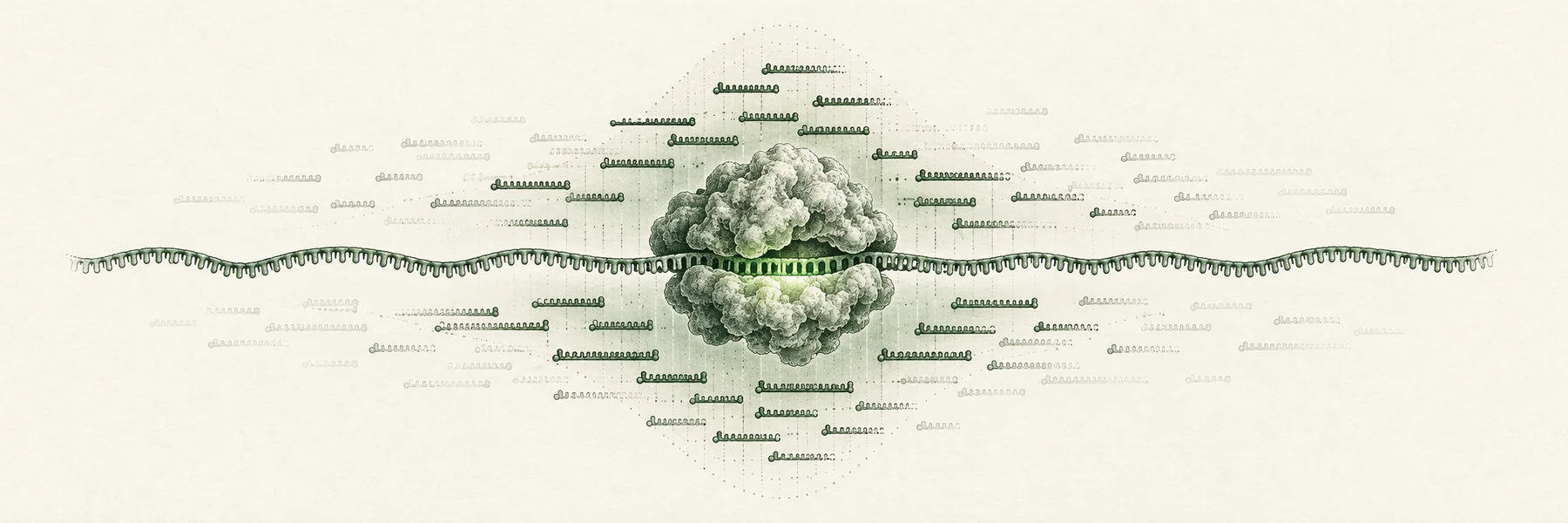
A ribosome is the molecular machine that reads RNA and builds proteins. Ribosome profiling, or Ribo-seq, takes a snapshot of this reading. Scientists add an enzyme that chews up RNA the ribosomes are not covering, then sequence the surviving pieces, called ribosome-protected fragments. Mapping those pieces back to the genome shows where ribosomes were working.2
An open reading frame (ORF) is a stretch of code that starts with a start signal and runs to a stop signal. Many ORFs sit outside annotated genes, such as upstream of a gene or inside long non-coding RNAs. These non-canonical ORFs matter because some produce small proteins, and the authors note that a substantial fraction of peptides displayed to the immune system come from them.1 A community effort to build a standard catalog gathered 7,264 human Ribo-seq ORFs from seven publications. Only 3,085 were found by more than one publication, which shows how hard consistent calling is.3
One reason is a signal called 3-nucleotide periodicity. Ribosomes move one codon (three letters of code) at a time, so good data show read positions repeating in threes. Most tools lean on that rhythm.1 A 2024 comparison of five tools on small ORFs found surprisingly low agreement, and some tools handled low-resolution data poorly.5
The new paper points at a cause that tools tend to skip. Many tools assign each fragment to a spot inside the ribosome, the P-site, using a fixed rule based on fragment length. But the lab steps distort fragments. The chewing enzyme (RNase I, MNase, or nuclease P1) cuts differently. The step that attaches adapters prefers certain ends. Reverse transcription can add stray letters. Together these blur the rhythm that tools rely on.1
Methodology and results
The idea. RiboBA treats the data as a story with a hidden step. The true P-site is hidden, and the observed fragment is what the lab method produced from it. The model describes how fragments arise from P-sites, including the enzyme's cutting pattern, the adapter preference, and stray letters. It fits those bias settings and ribosome counts per codon together by alternating guesses and updates, a procedure called expectation-maximization.1
Instead of forcing each fragment into one spot, RiboBA spreads it across every spot that fits, weighted by probability. The authors say this restores rhythm the bias had weakened.1 Then a random forest, a model built from many decision trees, scores candidate ORFs, and a second model called XGBoost picks the likely start codon.1
Why this design. A reasonable comparison is the fixed-offset approach, which is simpler but commits to one answer per fragment length. The authors argue it discards protocol information that a model could use.1
Simulations with known answers. Real data cannot reveal the true P-site, so the team simulated reads from known positions. In three independent simulations per condition, RiboBA put more reads at the exact correct nucleotide than the fixed-offset tool riboWaltz: 73.7 versus 22.7 percent for RNase I, 22.1 versus 8.7 for MNase, and 39.5 versus 11.9 for nuclease P1. At the codon level it reached 96.0 versus 78.0, 68.8 versus 29.1, and 77.6 versus 38.4 percent.1
For ORF detection, the team simulated 250 translated non-canonical ORFs per protocol and an equal number of non-translated ones. Compared with five other tools, RiboBA had the highest scores for separating the two groups and covered nearly the whole set. PRICE was second on accuracy but covered fewer ORFs.1 On one human dataset, RiboBA took 1.9 core-hours, against 2.7 for PRICE and 5.4 to 30.0 for the others.1
Real human data. The team curated nine human HEK293 or HEK293T libraries made with different protocols. RiboBA's inferred bias settings agreed between random halves of the same library, with correlations above 0.99, and in one MNase dataset it recovered the known preference of that enzyme for A and T bases.1 Other tools' counts of canonical ORFs swung from about 1,000 to 16,000 across protocols, while RiboBA found 11,000 to 12,000 in all of them.1
To check calls against something independent, the authors searched public immunopeptidomics data, mass-spectrometry readouts of peptides that cells display on their surface for the immune system. Overall support rates were around 2 percent, and about 6 percent for top-scoring upstream overlapping ORFs. RiboBA found the most supported upstream and upstream overlapping ORFs.1 For those two types it also showed high agreement between replicates while finding more candidates, though no tool led every type.1
A fruit fly case study. In three MNase datasets, RiboBA called several thousand non-canonical ORFs each. Their evolutionary coding signal was higher than matched background, a significant but modest shift. Among them were conserved upstream ORFs in the gene for threonyl-tRNA synthetase and in Mettl2, a tRNA-modifying gene, which the authors read as a possible regulatory link.1
Caveats. The simulations were built by the authors, and the empirical comparison used mostly human HEK293 cells. Low support rates mean most calls lack protein-level proof. Missing mass-spectrometry evidence does not show a call is wrong, since small proteins are hard to detect. RiboBA keeps one representative transcript per gene, and the authors say start-codon calls for weakly translated ORFs need caution.1 The work first appeared as a preprint, and this post did not replicate it.4
Future directions
The first two ideas come from the authors' stated future work. The third is this post's proposal. As of October 18, 2026, searches of PubMed, bioRxiv, and the web, followed by an independent attempt to find prior work, are summarized below. Anyone picking up an idea should repeat a fresh literature search before committing.
1. Bias-aware calling across several transcript versions of a gene. The authors plan to extend RiboBA across multiple isoforms.1 ORFquant already annotates and quantifies translation of ORFs on multiple isoforms per gene.6 The searches did not surface a non-canonical ORF caller that combines that with explicit protocol-bias modeling.
2. Pooling evidence across datasets to call non-canonical ORFs. The authors plan to integrate signals across datasets.1 Pooling across datasets has been modeled for ribosome occupancy: a September 2026 arXiv preprint, not peer reviewed, fits a shared sequence-dependent profile with a multiplicative correction for each dataset. Its corrections are learned rather than tied to named lab steps such as nuclease cutting or ligation, so the two are not equivalent. It predicts occupancy profiles over coding sequences and does not address ORF calling.8 The searches did not surface a pooled model that calls non-canonical ORFs while giving each library its own bias settings.
3. An independent benchmark matched by enzyme. The 2024 comparison studied agreement among tools and sensitivity to data quality, not matched enzymes.5 RiboBA's own benchmarks cover the enzymes, but its authors designed them. The searches did not surface a third-party benchmark that holds libraries matched across RNase I, MNase, and P1.
Why it matters
Cataloguing hidden genes requires tools that agree across labs. RiboBA argues that part of the disagreement is measurable lab bias rather than biology.
References & paper details
Paper details
- Venue: Nucleic Acids Research, volume 54, issue 19, 2026.1
- Publication date: 14 October 2026 on the publisher's page (PubMed lists 13 October). Received 7 April 2026, accepted 6 September 2026.
- Preprint: bioRxiv, March 2026.4
- Version analyzed: The published article's full text via PubMed Central.
- Peer review: Peer reviewed.
- Study type: Computational method with simulations and re-analysis of public sequencing data.
- Data: Public sequencing accessions in the paper's Supplementary Table S1 and the ProteomeXchange dataset PXD025449. Figure-ready data are on a separate Zenodo record (10.5281/zenodo.21648700).7
- Code: The RiboBA R package at github.com/Bai-JunYu/RiboBA. Analysis code is on Zenodo under the MIT License (version v0.9.0).7
- License: CC BY, per the publisher's page.
References
1. Central research paper
Junyu Bai and Ruolin Yang. RiboBA: a bias-aware probabilistic framework for robust ORF identification across diverse ribosome profiling protocols. Nucleic Acids Research 54(19), gkag969, 2026. DOI: 10.1093/nar/gkag969. PubMed, PubMed Central.
2. Ribosome profiling
Nicholas T. Ingolia, Sina Ghaemmaghami, John R. S. Newman, and Jonathan S. Weissman. Genome-wide analysis in vivo of translation with nucleotide resolution using ribosome profiling. Science 324, 218-223, 2009. DOI: 10.1126/science.1168978.
3. Standard catalog of Ribo-seq ORFs
Jonathan M. Mudge and colleagues. Standardized annotation of translated open reading frames. Nature Biotechnology 40, 994-999, 2022. DOI: 10.1038/s41587-022-01369-0.
4. Preprint version
Bai and Yang. RiboBA: a bias-aware probabilistic framework for robust ORF identification across diverse ribosome profiling protocols. bioRxiv, March 2026. Preprint version. DOI: 10.64898/2026.03.17.712439.
5. Comparison of ORF-calling tools
Gregory Tong, Nasun Hah, and Thomas F. Martinez. Comparison of software packages for detecting unannotated translated small open reading frames by Ribo-seq. Briefings in Bioinformatics 25(4), bbae268, 2024. DOI: 10.1093/bib/bbae268.
6. ORFquant
Lorenzo Calviello, Antje Hirsekorn, and Uwe Ohler. Quantification of translation uncovers the functions of the alternative transcriptome. Nature Structural & Molecular Biology 27, 717-725, 2020. DOI: 10.1038/s41594-020-0450-4.
7. Authors' code and data records
Bai and Yang. Supplementary figure-reproduction code for RiboBA (version v0.9.0, MIT License), Zenodo, 2026. DOI: 10.5281/zenodo.21648899.
8. Multi-dataset occupancy model
Gabriele Martino, Denis Skibinski, Ivo L. Hofacker, and Sebastian Tschiatschek. RiboUnmix: Learning Shared Translational Dynamics from Biased and Noisy Ribo-seq Measurements. arXiv 2609.39644, submitted 30 September 2026. Preprint, not peer reviewed. arXiv. Code: github.com/GabMartino/RiboUnmix.
Get the next breakdown
Subscribe for one email per issue — methods, limits, and what it actually means.
Related breakdowns
October 2026
AI Beat Docking at Poses, but Not Consistently at Finding Hits
A UCSF team tested three AI structure predictors on hundreds of brand-new crystal structures, then on long lists of candidate drugs. The AI won at drawing poses but did not consistently improve hit ranking.
Read breakdown →
October 2026
How Scientists Sorted 2.8 Million Bacterial Gene Clusters in Under 18 Hours
Bacteria keep related genes together in groups, and scientists now have millions of them to compare. IGUA groups them quickly by removing duplicates first, then comparing what is left.
Read breakdown →
September 2026
AI Models Can Mislead Each Other. A New Filter Decides Who Gets Heard.
A learned filter chooses which responses language models share during a debate. The study examines how message selection, recipient behavior, and training rewards shape the value of collaboration.
Read breakdown →