A New Tool Sorted 2.8 Million Bacterial Gene Clusters Into Families in 17 Hours
Bacteria keep related genes together in groups, and scientists now have millions of them to compare. IGUA groups them quickly by removing duplicates first, then comparing what is left.
· ~5 min read
The breakdown
Bacteria often store the instructions for a job in neighboring genes. A gene cluster is a stretch of DNA where genes that work together sit side by side. One famous type, the biosynthetic gene cluster (BGC), holds the recipe for a natural product such as an antibiotic. When researchers have millions of clusters, they need to know which ones are relatives. A new tool called IGUA does that sorting far faster than the established options.1
The gap
Related clusters are grouped into gene cluster families (GCFs). Grouping matters because it removes redundancy, lets scientists guess what an unknown cluster does from a known relative, and points to possible new clusters. Ordinary sequence tools such as BLAST or MMseqs2 compare single sequences. They do not handle clusters whose members share most genes but differ in a few, or have the genes in a different order.1
Two tools filled that role for BGCs. BiG-SCAPE describes each cluster as a string of protein domains, then combines three distance measures into one similarity score. It is accurate but slow, and the paper says its runtime grows quadratically with the number of clusters.1, 2 BiG-SLiCE is faster because it places clusters in a mathematical space and avoids comparing every pair, but it trades away some accuracy.1, 3 Both are built around BGCs, and both depend on Pfam, a library of known protein domains. A cluster with few recognizable domains is poorly served.1
IGUA, short for Iterative Gene clUster Analysis, aims to be fast, accurate, and usable for any kind of gene cluster.1
How IGUA works
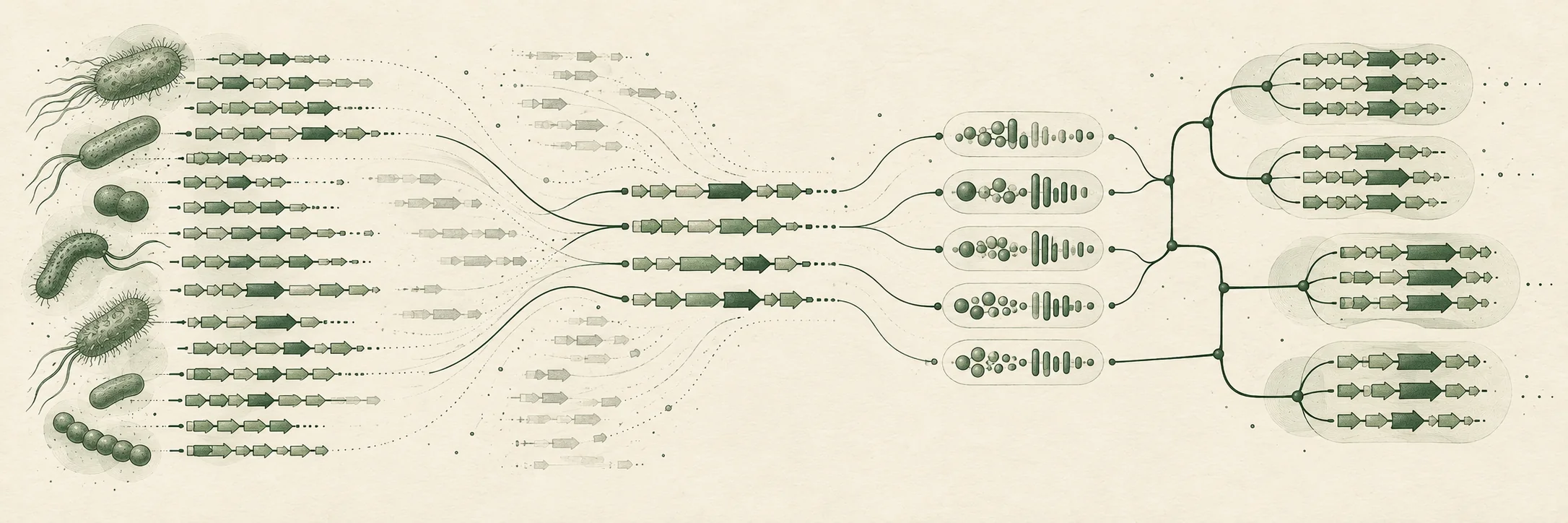
The central idea is to shrink the problem before doing the expensive part. IGUA runs three steps.1
First, it removes fragments: clusters that are just pieces of a larger, nearly identical cluster. This helps with data from metagenomes, which are DNA collected from whole microbial communities and often assembled in broken pieces. Second, it deduplicates, merging clusters whose DNA is nearly the same. Both steps use MMseqs2's Linclust program, a clustering method designed so that runtime grows in proportion to the amount of data rather than faster.1, 4
Third, it compares the survivors by protein content. All proteins are clustered into protein groups, ignoring their position. Each gene cluster then becomes a row of counts: how many proteins it has from each group. Distances between rows use the Manhattan distance, the sum of absolute differences in each count. Differences are weighted by protein length, so losing a large core gene counts for more than losing a small regulatory gene.1
Finally, hierarchical clustering builds a tree in which the most similar clusters merge first. Cutting the tree at a chosen distance yields the families. To pick that cutoff, the authors tested 800 combinations of linkage method and distance on a hand-curated set of 292 BGCs with known family labels. They scored the results with agreement measures such as the adjusted Rand index, and chose average linkage with a distance of 0.80.1
The older tools rely on Pfam domains. Counting MMseqs2 protein groups instead needs no outside library, so IGUA can handle clusters with little Pfam coverage. The paper states that IGUA does not rely on specific protein domains.1
What the paper reports
Accuracy. On the 292-BGC curated set, IGUA performed slightly better than BiG-SCAPE version 1 across many parameter settings. On a larger set of 15,298 BGCs, the two tools produced similar families, with a normalized mutual information of 0.83, or 0.82 once single-member families were removed. That number measures agreement between tools, not correctness. The accuracy comparison in the main text uses BiG-SCAPE version 1 only.1
Speed. The team clustered BGCs from five sets of about 5,000 genomes each. On one CPU, IGUA was 47 times and 10 times faster than BiG-SCAPE 1 and BiG-SLiCE 1, and 18 times and 6 times faster than the 2.0 versions. The abstract reports 29 times and 10 times faster than the 2.0 versions on 28 CPUs.1
Scale. Using 72 CPUs, IGUA grouped 2,829,071 BGCs into 56,960 families in 17 hours and 22 minutes. Of those families, 82.6 percent contained one biosynthetic class, and 96.7 percent contained no experimentally verified cluster, suggesting that most of this space has not been tested in a lab.1
Other cluster types. IGUA also grouped 10,576 secretion systems into 2,744 families in under three minutes on 28 CPUs. Type III secretion systems and flagella, two structures known to share ancestry, landed together at one setting and separated at a finer one. It sorted 25,197 plasmids, phages, and phage-plasmids into 5,165 families, 98.1 percent of which held only one of the three types.1
Limits the authors state. IGUA lacks BGC-specific features such as built-in comparison with a reference database. Its hierarchical step can be quadratic in the worst case, though the authors describe a linear alternative. Runtime depends on the data: the phage-plasmid set was about twice as large as the secretion system set but took over 14 times longer, because the early redundancy steps removed less.1 The accuracy tests also lean on one small curated set that was used to choose the settings. This post has not independently replicated any result.
Future directions
These are proposals, anchored to what the paper reports. As of October 16, 2026, each idea was searched in PubMed, Consensus, bioRxiv, and the web, then given a separate adversarial check. Anyone picking up one of these ideas should repeat a fresh literature search before committing to a project.
1. Test IGUA against product chemistry. Oyedele and colleagues built a benchmark that tests whether similar clusters make similar chemical products. It tested KnownClusterBlast, BiG-SCAPE 1.1.2, BiG-SLiCE 2.0.0, clust-o-matic, and lsaBGC, and did not mention IGUA or BiG-SCAPE 2.0.5 BiG-SCAPE 2.0's own paper compares IGUA on curated family datasets, not on that benchmark.6 The searches did not surface a study scoring IGUA, BiG-SCAPE 2.0, and BiG-SLiCE 2.0 together against chemical similarity. The benchmark's code is public, so the first step is to run it.
2. Swap the protein-group step for protein embeddings. A protein language model turns each protein into a numeric vector. The BGC-Finder preprint already uses such embeddings to compare BGCs, but it is a different pipeline.7 The searches did not surface a study that replaces IGUA's protein-group step with embeddings and measures family assignment against curated labels. This is partly explored, so start from BGC-Finder.
Why it matters
Genome databases keep growing, and a slow grouping step limits what a small lab can try. IGUA shows that careful data reduction can make an old question affordable to ask on millions of examples. The open question is how well its families match real chemistry and biology, and that is a good place to start.
References & paper details
Paper details
- Venue: Nucleic Acids Research, volume 54, issue 19.1
- Publication date: Published online October 13, 2026, per PubMed. A bioRxiv preprint with the same title was posted earlier.8
- Version analyzed: The journal version's full text via PubMed Central.
- Peer review: Peer reviewed.
- Study type: Computational method development and benchmarking, no new wet-lab data.
- Code: github.com/zellerlab/IGUA, listed in the abstract. Documentation and PyPI list GPL-3.0-or-later.9 The paper used version 0.1.0.
- License: PubMed lists the copyright as "© The Author(s) 2026. Published by Oxford University Press" and reports no open-access license. Check the publisher page for reuse terms. This post is an independent summary.
References
1. Central research paper
Martin Larralde, Josefin Blom, Hadrien Gourlé, Hale-Seda Radoykova, Lucas Paoli, Georg Zeller, and Laura M. Carroll. Fast, flexible gene cluster family delineation with IGUA. Nucleic Acids Research 54(19), 2026. DOI: 10.1093/nar/gkag975. PubMed, PubMed Central.
2. BiG-SCAPE
Jorge C. Navarro-Muñoz and colleagues. A computational framework to explore large-scale biosynthetic diversity. Nature Chemical Biology 16, 60-68, 2020. DOI: 10.1038/s41589-019-0400-9.
3. BiG-SLiCE
Satria A. Kautsar, Justin J. J. van der Hooft, Dick de Ridder, and Marnix H. Medema. BiG-SLiCE: A highly scalable tool maps the diversity of 1.2 million biosynthetic gene clusters. GigaScience 10, 2021. DOI: 10.1093/gigascience/giaa154.
4. Linclust
Martin Steinegger and Johannes Söding. Clustering huge protein sequence sets in linear time. Nature Communications 9, 2542, 2018. DOI: 10.1038/s41467-018-04964-5.
5. Chemistry-based BGC benchmark
Oyedele and colleagues. Benchmarking methods for measuring biosynthetic gene cluster similarity and determination of gene cluster families. Bioinformatics 41(12), 2025. DOI: 10.1093/bioinformatics/btaf636. Code: aswalker-lab/BGC-clustering-benchmark.
6. BiG-SCAPE 2.0 and BiG-SLiCE 2.0
Arjan Draisma and colleagues. BiG-SCAPE 2.0 and BiG-SLiCE 2.0: scalable, accurate and interactive sequence clustering of metabolic gene clusters. Nature Communications 17, 2026. DOI: 10.1038/s41467-026-68733-5.
7. BGC-Finder preprint
Zi-Xin Kang and colleagues. Uncovering Microbial Biosynthetic Potential with Genomic Context-aware Protein Language Model. bioRxiv, 2025. Preprint, not peer reviewed. DOI: 10.1101/2025.04.29.651206.
8. IGUA preprint
Larralde and colleagues. Fast, flexible gene cluster family delineation with IGUA. bioRxiv, 2025. Preprint version. DOI: 10.1101/2025.05.15.654203.
9. IGUA software documentation
Get the next breakdown
Subscribe for one email per issue — methods, limits, and what it actually means.
Related breakdowns
September 2026
AI Models That Shared Only Some of Their Answers Beat Full Sharing on Hard Math, 68% to 66%
A learned filter chooses which responses language models share during a debate. The study examines how message selection, recipient behavior, and training rewards shape the value of collaboration.
Read breakdown →
September 2026
A New Method Covered 60% of a Deliberately Tricky Test Where the Standard Shortcut Reached 46%
A shared training framework turns neural-network scores into valid candidate solutions. Its experiments show where learned combinations help and how solution quality trades off against computation.
Read breakdown →
September 2026
Wiring an AI's Neurons to the Right Inputs Made It Better at Recognizing Gestures and Objects
Controlled experiments show why an artificial neuron's choice of inputs matters. Useful sensory organization improves recognition, and its value changes with the neuron's internal memory.
Read breakdown →