Task-Aligned Input Wiring Helps Recurrent Networks Classify Sensory Data
Controlled experiments show why an artificial neuron's choice of inputs matters. Useful sensory organization improves recognition, and its value changes with the neuron's internal memory.
· ~5 min read
The breakdown
Two artificial networks can have the same connection budget and still learn differently because they receive information in different arrangements. This study asks whether giving each neuron a meaningful subset of sensory inputs improves recognition, and whether a more capable neuron needs that guidance as much. The experiments connect accuracy differences to specific properties of the wiring, rather than simply comparing a larger model with a smaller one. 1, Sections 3–4.
What changed
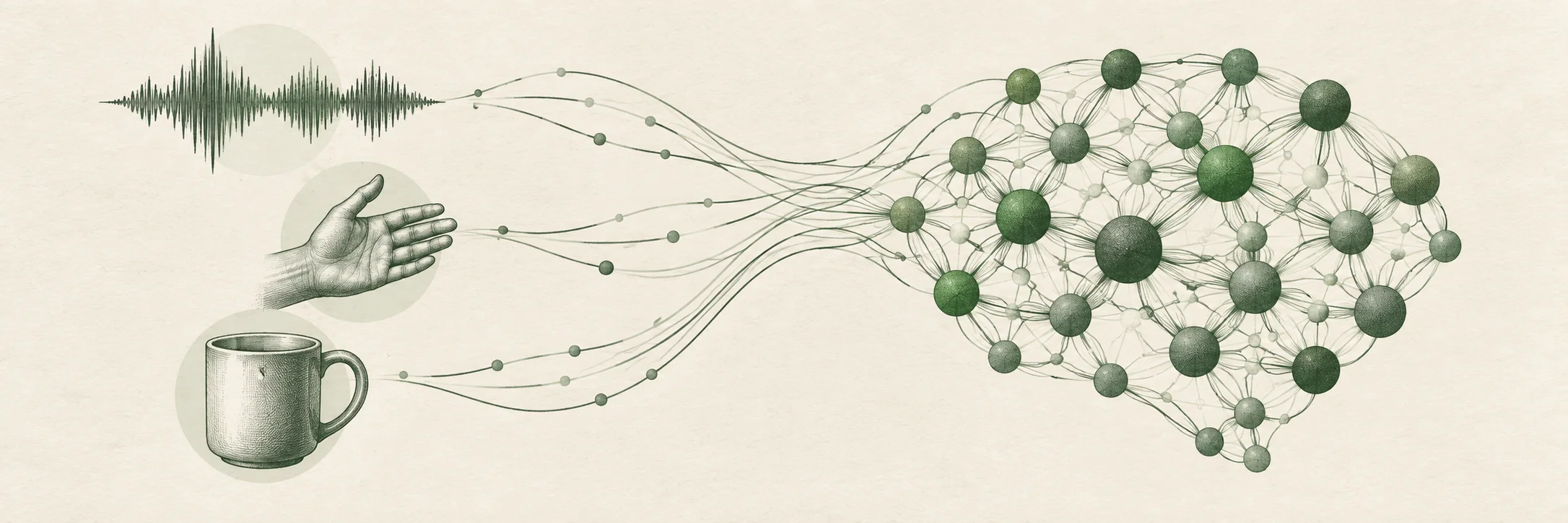
A receptive field is the set of sensory inputs available to a neuron. Here, a neuron is a computational unit, not a biological cell. A unit might receive neighboring sound-frequency channels, information about one direction of movement, or a local patch of an image. The researchers compare these organized arrangements with randomly selected inputs. 1, Section 3.3.
The networks use Expressive Leaky Memory (ELM) neurons. Each unit maintains internal memory states that retain information over different timescales. Adding more memory states makes an individual unit capable of richer temporal processing; adding more neurons makes the whole network wider. The study varies these separately to ask whether useful input structure and internal computational capacity can partly substitute for one another. 1, Section 3.2.
How the method works
The team uses three recognition tasks. Spoken digits are represented as activity across sound-frequency channels. Gestures and objects come from event cameras, which record changes in brightness rather than conventional full video frames. Gesture identity depends strongly on movement, while object identity in the selected dataset depends more on spatial shape: the recording procedure moves all object classes in a shared way. 1, Section 3.1.
This distinction creates a useful experimental contrast. For gestures, wiring organized by movement direction should be informative. For objects, wiring organized by position should help more. Testing both arrangements on both tasks asks whether any orderly connection pattern is beneficial, or whether that order must match information useful for the task. Motion information is extracted during preprocessing, so the comparison concerns the resulting input representation as well as the network that receives it.
Within structured-versus-random comparisons, the researchers match trainable parameter counts, synaptic budgets, and training procedures. A synapse here means a connection carrying information into a unit. The structured conditions fix the allocation between incoming sensory and recurrent connections; the random controls match its expected proportion. These controls make “it just has more connections” an inadequate explanation for an observed advantage. 1, Sections 3.2–3.3.
Each condition is trained ten times with new initial parameters and connectivity. The data partitions remain fixed across those runs, so each condition sees the same training and evaluation examples. Statistical comparisons use a test that accommodates unequal variation between conditions, followed by a correction for the many comparisons performed. This estimates variation from training and wiring, rather than variation across entirely new datasets. 1, Section 3.4 and Appendix B.
The strongest mechanism check scrambles the sensory ordering before constructing the organized fields. The number of connections and their overlap remain, but “neighbors” no longer correspond to meaningful nearby inputs. If the benefit survives, connectivity alone could explain it. If it disappears, the content of the organization matters. This is a targeted intervention on the explanation the authors want to test. 1, Section 4.2.
What the experiments show
At the highlighted setting of 128 units with three memory states each, motion-aligned wiring improves gesture accuracy by 4.58 percentage points over its random control. Spatial wiring improves object accuracy by 4.02 points over its own random control. Both comparisons meet the paper's threshold after adjustment for multiple tests. Percentage points are differences between percentages, rather than proportional increases. 1, Table 4.
The alternative alignments do not show statistically significant improvements in those highlighted tests. That pattern supports task relevance: motion organization is useful for these gestures, while spatial organization is useful for these objects. Because the preprocessing differs between alignment conditions, the clean comparison is each arrangement against its matched random control, not a direct ranking of every raw accuracy in the figure. 1, Section 4.2 and Appendix A.2.
Scrambling provides a second line of evidence. For spoken digits, the structured-wiring advantage changes from +2.49 points to −0.49 points after meaningful frequency ordering is disrupted; the latter difference is not statistically significant. The result supports an explanation based on useful sensory neighborhoods, rather than sparse wiring alone. It does not establish that the scrambled networks are exactly equivalent. 1, Figure 3 and Table 4.
The capacity experiment adds nuance. For gestures, the advantage is 4.58 points with three memory states, 7.36 with thirteen, and 2.47 with twenty-one. The higher-capacity endpoint has a smaller advantage, but the intermediate rise shows that the relationship is not a steady decline. Input organization and memory interact in a task-dependent way. 1, Figure 2D and Table 4.
A further experiment encourages many input weights to become small, a technique called sparsity regularization. It improves spoken-digit recognition and produces coarse frequency selectivity in initially unrestricted networks. The remaining accuracy difference from explicitly structured wiring is not statistically significant in the highlighted adjusted comparison. This makes learned selectivity a promising direction without establishing that it fully reproduces the same organization. 1, Section 4.3 and Table 4.
Where the research can go next
The authors identify testing additional sensory geometries and neuron architectures as a next step. That follows directly from the design: the current experiments vary several tasks and capacities within one model family. Repeating the matched-wiring controls elsewhere would test how broadly the trade-off between input structure and internal processing applies. 1, Section 5.
Our further inference is to turn imposed wiring into a learnable choice. The regularization experiment already shows some selectivity emerging. A follow-up could compare fixed receptive fields, learned input selection, and random wiring at matched budgets, including the cost of learning that selection. The question would be whether a network can discover useful sensory neighborhoods when researchers do not specify them in advance.
Why it matters
Choosing which information reaches a unit can be as consequential as increasing what that unit can compute. The paper's contribution is the controlled evidence linking those choices. It offers a framework for designing more effective sensory networks and a starting point for studying how useful organization might emerge during learning.
References & paper details
Paper details
- First public availability: September 23, 2026 in America/Chicago, based on arXiv's September 24 announcement listing and its evening release schedule. The manuscript's September 22 submission date is separate. 2
- Repository: arXiv, cs.NE; arXiv:2609.26940.
- Version analyzed: v1, submitted September 22, 2026 at 18:27:58 UTC. 1
- Peer review: preprint; peer review of this version is not verified. The manuscript names a workshop, which alone does not establish acceptance or review.
- Study type: controlled computational experiments on auditory and event-camera classification datasets.
References
1. Central paper
Agnese Adorante, Aaron Spieler, and Anna Levina. The Computational Value of Sensory-Aligned Receptive Fields Depends on Neuronal Expressivity. arXiv:2609.26940, v1 submitted September 22, 2026; first announcement listing September 24, corresponding to September 23 in America/Chicago under arXiv's release schedule. Preprint; peer review of the analyzed version not verified. Version record · Full v1 paper · PDF with numbered figures. Released under CC BY 4.0; this article provides an independently written analysis.
2. Release-date evidence
arXiv. Neural and Evolutionary Computing announcement listing, September 24, 2026 section, arXiv:2609.26940; and Availability of submissions, announcement schedule. The listing is a changing page; the distinction between listing date and submission date is retained in the editorial record.
Get the next breakdown
Subscribe for one email per issue — methods, limits, and what it actually means.
Related breakdowns
October 2026
A New Tool Sorted 2.8 Million Bacterial Gene Clusters Into Families in 17 Hours
Bacteria keep related genes together in groups, and scientists now have millions of them to compare. IGUA groups them quickly by removing duplicates first, then comparing what is left.
Read breakdown →
September 2026
CPP tests selective communication in three-model AI debates
A learned filter chooses which responses language models share during a debate. The study examines how message selection, recipient behavior, and training rewards shape the value of collaboration.
Read breakdown →
September 2026
Frank–Wolfe Decomposition Gives Neural Optimizers Feasible Candidates
A shared training framework turns neural-network scores into valid candidate solutions. Its experiments show where learned combinations help and how solution quality trades off against computation.
Read breakdown →