AI Beat Docking at Poses, but Not Consistently at Finding Hits
A UCSF team tested three AI structure predictors on hundreds of brand-new crystal structures, then on long lists of candidate drugs. The AI won at drawing poses but did not consistently improve hit ranking.
· ~5 min read
The breakdown
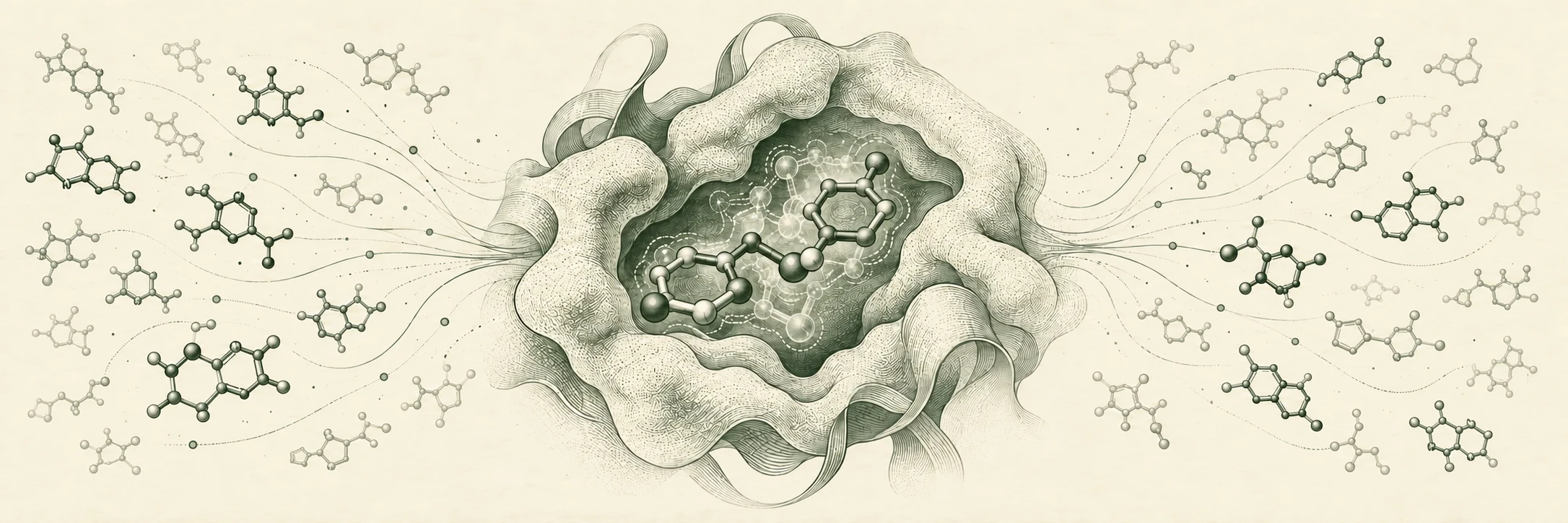
Designing a drug often starts with a picture: where does a small molecule sit inside its protein target, and how tightly does it hold on? A new wave of AI tools, called co-folding models, predicts that picture directly from the protein's amino-acid sequence and the molecule's chemical formula. A study published in eLife on October 12, 2026 puts three of them to a hard test.1
The gap
AlphaFold 3 can predict how proteins interact with small molecules, and its authors reported higher accuracy than state-of-the-art docking tools.3 Docking is the older approach. It tries many orientations of a molecule inside a fixed protein structure and scores each one with a physics-inspired formula. Newer co-folding tools include Chai-1 and Boltz-2, which also predicts binding strength.4
Two worries followed. One benchmark of 2,600 protein-ligand systems found that accuracy falls as molecules look less like those in the training data, which suggests memorization.5 A second study altered binding-site residues in ways that should prevent a ligand from binding, and AlphaFold 3 often still placed the ligand in or near its original spot.6 The new paper says a missing piece was large tests on data the models never saw, plus tests that look like real drug discovery.1
Methodology and results
Test one: drawing the pose. The team had solved hundreds of crystal structures of a viral enzyme, the SARS-CoV-2 macrodomain Mac1, bound to molecules from a drug-discovery effort, mostly early fragments and early lead compounds. They used 551 that had not been published before, of which 489 had clear enough data to judge. Each model got only the protein sequence and the molecule's text-based chemical description. The classic method, a program called DOCK3.7, was given a structure of the enzyme. Success meant the predicted molecule landed within 2 angstroms (2 ten-billionths of a meter) of the real position, measured as root-mean-square deviation.1
Of the 489 usable structures, AlphaFold 3 and Chai-1 got roughly 70 percent right, Boltz-2 53 percent, and DOCK3.7 40 percent. A few molecules per method dropped out after chemistry checks.1 The authors checked for memorization by comparing each molecule with the most similar one deposited before the training cutoff. Prediction error showed no meaningful link to that similarity.1
The weak spots were large shape changes. The enzyme sometimes flips a stretch of its backbone near one amino acid or opens a loop to hold certain molecules. AlphaFold 3 got 4 of 19 backbone flips and 0 of 20 loop openings, and it predicted eight flips that did not occur. Molecules were often placed correctly anyway. The authors read this as a sign the models learn interaction patterns more than physics.1
Test two: scoring strength. Models also report how confident they are. Across the evaluable poses, those confidence scores separated correct poses from wrong ones with an AUC (area under a curve, where 50 means a coin flip and 100 means perfect) of 75.6 for AlphaFold 3 and 74.6 for Chai-1, versus 67.1 for DOCK3.7. For 202 molecules the team also measured potency, the concentration that blocks half of the enzyme's activity. Boltz-2's affinity prediction tracked measured potency best, with a correlation of about 0.6 (1 is perfect, 0 is none). It tended to guess molecules were too potent. After fitting a straight line to correct that, its average error fell from about 1.6 to about 0.7 kcal/mol, a unit of energy. Guessing the average potency every time gave 0.93. DOCK3.7's score correlated weakly.1
Test three: finding real hits. Large-library docking screens rank hundreds of millions to billions of molecules, then test the top picks.7, 8 The team took three such campaigns with experimental results: 506 molecules for the sigma-2 receptor, 1,293 for the enzyme AmpC beta-lactamase, and 541 for the dopamine D4 receptor. Each list mixed true binders with high-scoring false alarms. The question was whether co-folding could tell them apart.1
It mostly could not beat docking. Listing sigma-2, AmpC, and dopamine D4 in that order, DOCK3.7 reached AUCs of 78.8, 76.5, and about 71, while AlphaFold 3 reached 56.1, 60.5, and 46.4. Boltz-2 scored 83.8, 68.1, and about 71, so it beat docking on sigma-2, tied it on D4, and lagged on AmpC. The authors note docking is about four orders of magnitude faster.1
Why these choices. Mac1 supplied many structures determined after the models' training cutoffs, and the docking campaigns supplied experimentally tested hits and misses. The authors say judging independence from training data has hampered fair evaluation.1 A reasonable alternative is a retrospective benchmark of older public structures, though the models may have already seen similar answers there. The "predict the average" baseline is a useful guard, because it shows whether a model beats a trivial guess on a narrow range of potencies.
Caveats the authors state. Mac1 molecules fall into just four scaffold families, which may inflate pose success. The hit lists were selected by docking in the first place, which favors docking, and cover only three targets.1 Some potency thresholds for "true hit" were relaxed from earlier studies. This post has not independently replicated any result. The work first appeared as a bioRxiv preprint in December 2025. This post summarizes the eLife version.2
Future directions
These are proposals, not claims from the paper. As of October 17, 2026, each was searched in PubMed, Consensus, bioRxiv, and the web, then checked by an independent search that tried to find prior work. Anyone picking up an idea should repeat a fresh literature search before committing.
1. Recover the missed Mac1 shape changes. The paper reports the flip and loop failures above.1 Related methods exist for other proteins. Boltz-Perturb nudges Boltz-2's inputs to explore more binding poses, tested on a Runs N' Poses benchmark subset and some new complexes.9 Pair representation scaling broadens the shapes AlphaFold 3 and Boltz-2 sample, tested on 86 two-state targets.10 The searches did not surface a study applying such methods to the Mac1 backbone flip or loop opening, and the deposited structures could serve as a test set.
2. Test a combined score with new experiments. The authors suggest docking and co-folding errors are partly independent.1 Part of this is already explored. A preprint from Menon and colleagues used an AlphaFold 3 confidence filter inside docking-score bins on retrospective data, and its prospective sigma-2 screen picked molecules by docking or by AlphaFold 3 separately, with hit rates of 25 percent (27 of 108) and 13 percent (15 of 114).11 Bret and colleagues studied Boltz-2 on docking hits retrospectively.12 The searches did not surface a single combined score whose top picks were then synthesized and assayed.
3. Rank molecules within one chemical series. The discussion proposes that co-folding may help most after a series is found.1 Amini and colleagues fine-tuned Boltz-2 on company data and compared it with a physics-based method, but did not use Mac1.13 The searches did not surface a Mac1 study of this kind. Note that the paper's 202 potencies skew toward weaker molecules, so the range is narrow.
Why it matters
Structure prediction has already changed biology, so it is easy to assume it will also pick drugs. This paper suggests it is not that simple. The AI tools draw a familiar type of binder well, while the older method is still hard to beat at sifting a big, diverse list.
References & paper details
Paper details
- Venue: eLife, volume 15, 2026.1
- Publication date: October 12, 2026, per PubMed.
- Preprint: The same work was posted on bioRxiv in December 2025 under a slightly different title, reporting 557 Mac1 complexes.2
- Version analyzed: The eLife version's full text via PubMed Central.
- Peer review: Peer reviewed.
- Study type: Computational benchmarking with new X-ray crystallography data and potency measurements.
- Data: According to the preprint's data statement, Mac1 structures are deposited in the Protein Data Bank, and predictions, scores, and screening compounds are in supplementary files.2
- Code: Analysis scripts at github.com/jongbin99/Cofolding. The preprint's Methods list this address.
- Copyright: PubMed lists "© 2026, Kim, Correy, Hall et al."
References
1. Central research paper
Jongbin Kim, Galen J. Correy, Brendan W. Hall, and colleagues, including Brian K. Shoichet and James S. Fraser. Large-scale prospective evaluation of co-folding across hundreds of Mac1-ligand complexes and three virtual screens. eLife 15, 2026. DOI: 10.7554/eLife.110475. PubMed, PubMed Central.
2. Preprint version
Kim and colleagues. Large scale prospective evaluation of co-folding across 557 Mac1-ligand complexes and three virtual screens. bioRxiv, December 2025. Preprint version. DOI: 10.64898/2025.12.25.696505.
3. AlphaFold 3
Josh Abramson and colleagues. Accurate structure prediction of biomolecular interactions with AlphaFold 3. Nature 630, 493-500, 2024. DOI: 10.1038/s41586-024-07487-w.
4. Boltz-2
Saro Passaro and colleagues. Boltz-2: Towards Accurate and Efficient Binding Affinity Prediction. bioRxiv, 2025. Preprint, not peer reviewed. PubMed Central. Code: github.com/jwohlwend/boltz.
5. Runs N' Poses benchmark
Peter Škrinjar and colleagues. Have protein-ligand cofolding methods moved beyond memorisation? bioRxiv, 2025 (DOI: 10.1101/2025.02.03.636309); published as Evaluating generalization in protein-ligand cofolding methods, Nature Structural & Molecular Biology 33, 782-794, 2026.
6. Physics test with binding-site mutations
Matthew R. Masters, Amr H. Mahmoud, and Markus A. Lill. Investigating whether deep learning models for co-folding learn the physics of protein-ligand interactions. Nature Communications 16, 8854, 2025. DOI: 10.1038/s41467-025-63947-5.
7. Ultra-large library docking
Jiankun Lyu and colleagues. Ultra-large library docking for discovering new chemotypes. Nature 566, 224-229, 2019. DOI: 10.1038/s41586-019-0917-9.
8. Sigma-2 receptor screen
Assaf Alon and colleagues. Structures of the sigma-2 receptor enable docking for bioactive ligand discovery. Nature 600, 759-764, 2021. DOI: 10.1038/s41586-021-04175-x.
9. Boltz-Perturb
Hyeyun Jung, BoRam Lee, and Alan C. Cheng. Boltz-Perturb: Improving Diversity and Accuracy in Protein-Ligand Co-Folding through Training-Free Conditioning Perturbation. bioRxiv, 2026. Preprint, not peer reviewed. DOI: 10.64898/2026.08.05.742877.
10. Pair representation scaling
Shosuke Suzuki and Toshiyuki Amagasa. Biasing Conformational Sampling in AlphaFold 3 and Boltz-2 via Pair Representation Scaling. Journal of Chemical Information and Modeling 66(17), 10862-10876, 2026. DOI: 10.1021/acs.jcim.6c02094.
11. AlphaFold 3 versus docking
Kartikeya M. Menon and colleagues, with Assaf Alon and Jiankun Lyu. AlphaFold3 for Structure-guided Ligand Discovery. bioRxiv, 2026. Preprint, not peer reviewed. DOI: 10.64898/2025.12.04.692352.
12. Boltz-2 on docking hits
G. Bret, F. Sindt, and D. Rognan. Assessing Boltz-2 Performance for the Binding Classification of Docking Hits. Journal of Chemical Information and Modeling 66, 2026. DOI: 10.1021/acs.jcim.5c02630.
13. Fine-tuning Boltz-2 for potency
Samad Amini, Simone Sciabola, and Ye Wang. Affinity Fine-Tuning of Boltz-2: An Open Framework for Protein-Ligand Potency Prediction in Drug Discovery. bioRxiv, 2026. Preprint, not peer reviewed. DOI: 10.64898/2026.05.26.727958.
Get the next breakdown
Subscribe for one email per issue — methods, limits, and what it actually means.
Related breakdowns
October 2026
How Scientists Sorted 2.8 Million Bacterial Gene Clusters in Under 18 Hours
Bacteria keep related genes together in groups, and scientists now have millions of them to compare. IGUA groups them quickly by removing duplicates first, then comparing what is left.
Read breakdown →
September 2026
AI Models Can Mislead Each Other. A New Filter Decides Who Gets Heard.
A learned filter chooses which responses language models share during a debate. The study examines how message selection, recipient behavior, and training rewards shape the value of collaboration.
Read breakdown →
September 2026
Can AI Make Valid Decisions Without Being Shown the Right Answers?
A shared training framework turns neural-network scores into valid candidate solutions. Its experiments show where learned combinations help and how solution quality trades off against computation.
Read breakdown →