Colossal Gave Mice Mammoth-Style Fur. Its Goal Is a Cold-Resistant Elephant by 2028
Colossal Biosciences created mice with mammoth-like fur. It's a proof of concept for de-extinction, and it raises real questions about whether we should.
· ~5 min read
The breakdown
The Breakthrough
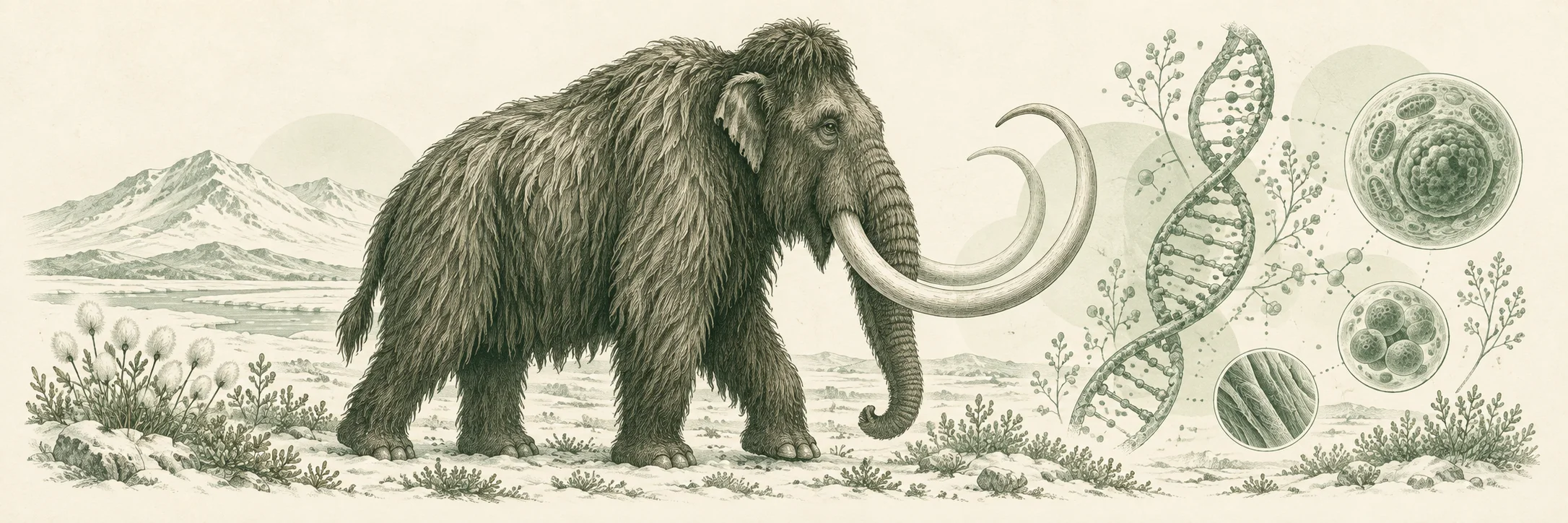
Colossal Biosciences, the company working to bring back the woolly mammoth, announced a key milestone: "woolly mice." These are lab mice engineered with mammoth-like fur traits using gene editing. It's not a mammoth. It's not even close. But it proves that the core technique works: you can identify cold-adaptation genes from extinct species and insert them into a living animal, and the animal will express the trait.
The company's full goal is ambitious: create a cold-resistant elephant with mammoth traits by 2028. Asian elephants are the mammoth's closest living relatives. Colossal's plan is to edit key cold-adaptation genes into Asian elephant cells, including hair density, fat storage, ear size (smaller ears lose less heat), and hemoglobin that works better in cold. They then plan to use those cells to create an embryo carried by a surrogate.
Why It Matters
The ecological argument is interesting. Mammoths helped maintain Arctic grasslands by knocking down trees and trampling snow, which kept the ground frozen. Without them, those grasslands turned into forests, and the permafrost started thawing, releasing stored carbon and methane. Some researchers argue that reintroducing mammoth-like animals could help slow permafrost melting and, by extension, climate change.
The biotech argument is more straightforward. If you can edit enough genes in the right way to give a mouse mammoth fur, you can probably do something similar in a larger animal. The woolly mice are proof that the pipeline, from identifying ancient genes to editing them into a modern genome to producing a viable animal, actually works end to end.
The Counterarguments
Critics point out that the resources going into de-extinction could be spent on conservation of currently endangered species. There are rhinos, tigers, and orangutans that need help right now, and they argue that creating a mammoth-like elephant is a vanity project when so many existing species are on the brink.
There's also the question of whether a mammoth-like animal could actually survive in today's Arctic. The ecosystem it evolved in doesn't exist anymore. The permafrost is thawing. The vegetation has changed. Reintroducing a single species into an environment that's shifted dramatically over 13,000 years isn't a guaranteed success. It might not even be possible.
One mammoth-like elephant on a preserve is not going to restore Arctic grasslands.
My Take
I think the technology behind this is genuinely cool and worth pursuing. Gene editing at this level of precision, which means identifying specific cold-adaptation genes from ancient DNA and successfully inserting them into a living genome, is meaningful biotech progress regardless of whether a mammoth ever walks the tundra again.
But I don't find the ecological argument fully convincing. One mammoth-like elephant on a preserve is not going to restore Arctic grasslands. The scale needed for that kind of ecological impact is hundreds of animals across thousands of square miles, in an environment that's actively changing due to climate change. If the goal is permafrost preservation, there are probably more direct and scalable approaches than resurrecting a Pleistocene megafauna.
That said, the gene editing tools Colossal is developing will have applications well beyond de-extinction: better understanding of cold adaptation, improvements in synthetic biology, advances in embryo manipulation. The mammoth is the headline, but the fundamental biology work is where the real value is.
The mammoth is the headline, but the fundamental biology work is where the real value is.
Get the next breakdown
Subscribe for one email per issue — methods, limits, and what it actually means.
Related breakdowns
April 2025
Colossal's "Dire Wolves" Are Gray Wolves With 20 Gene Edits
Three wolf pups engineered to resemble extinct dire wolves. The biotech is impressive, but the "de-extinction" label deserves scrutiny.
Read breakdown →
January 2026
Biotech Can Now Insert Up to a Million DNA Letters. The Hard Part Is Getting It to Patients
2025 was not just another productive year for biotech. Multiple technologies reached new levels of practical impact. Here is what comes next.
Read breakdown →