A Synthetic Organelle Preserves Traces of Past Gene Activity in Human Cells
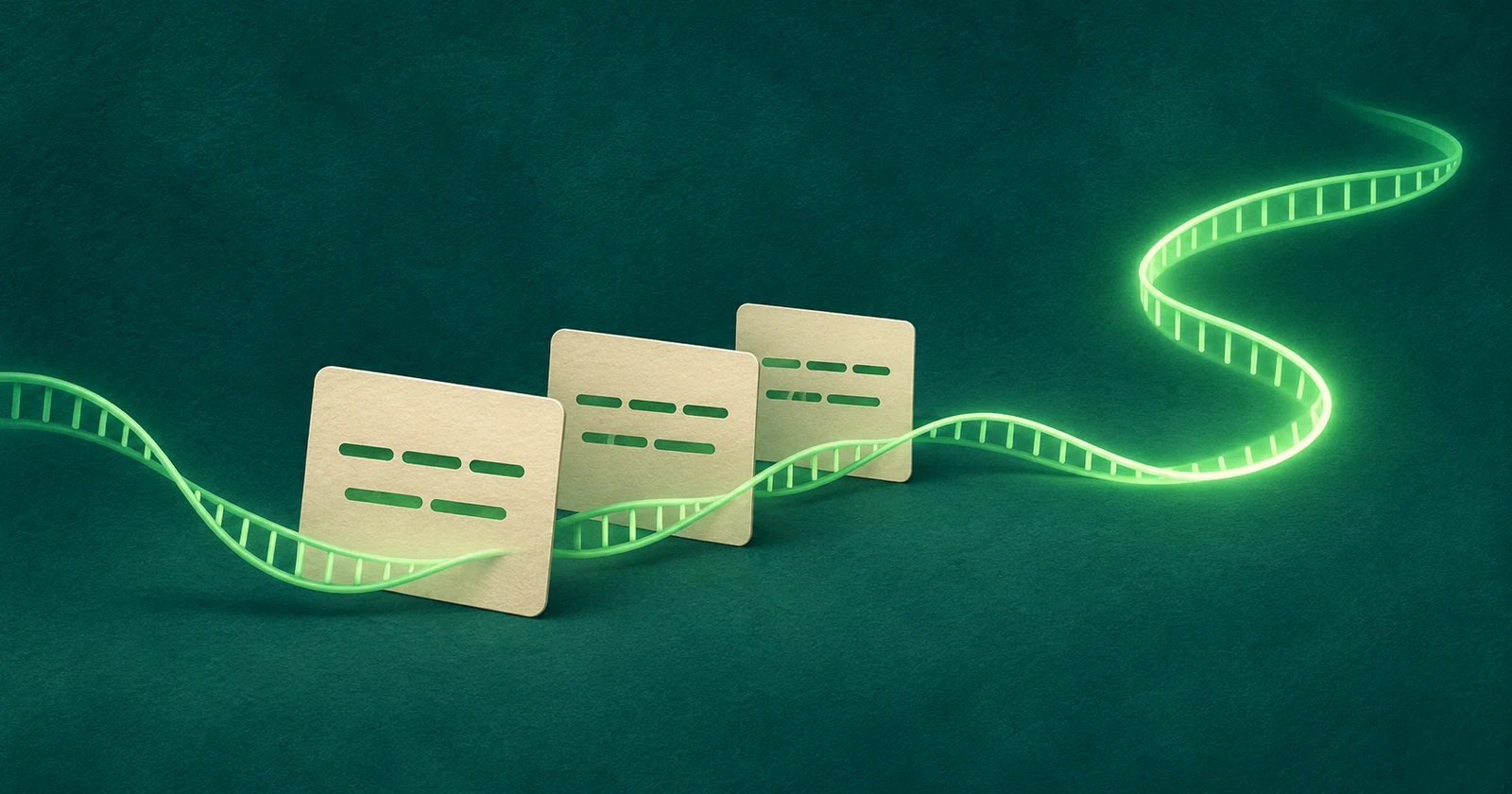
A brief burst of gene activity can disappear before a cell is measured. An RNA-holding structure may preserve its trace.
Peer reviewedKey takeaways
- Broad RNA capture could let researchers examine recent activity without choosing every gene in advance.
- The result comes from one cell line and mainly one signaling pathway. Primary cells and living tissue still need testing.
- Cell-health assays detected no obvious damage relative to a non-recording control, but they cannot exclude costs those assays missed.
Standard single-cell RNA sequencing reads a cell once, at lysis. Existing transcriptional recorders can follow chosen genes over time, leaving a trade-off between breadth and access to earlier activity. [1]
The finding
RNA capture beyond a single snapshot
Standard single-cell RNA sequencing is destructive: it reads the cell's transcriptome once, at the moment of lysis, and that cell is gone. Methods built to track gene activity over time, such as CRISPR-based transcriptional recorders, go the other direction: they can watch a handful of chosen genes for a long stretch, but not the whole transcriptome. The recordanelle is pitched as a way to get both at once: a structure that samples broadly across expressed genes, holds what it captures for multiple days, and can still be read out with single-cell resolution [1]. The authors present it as a third option alongside existing methods, trading some completeness of a single-moment snapshot for the ability to look backward in time.
Tracing brief cellular events
A great deal of cell biology happens in events too brief or too rare to be caught by sequencing a population at a single moment. If the approach generalizes, it offers a way to trace a cell's recent activity alongside its current state, without deciding in advance which genes were worth watching. The caveats are real: this is a proof of concept in one lab-grown cell line, built mainly around one endogenous signaling pathway and its withdrawal time course, the recording structure is itself an addition that could carry costs the current assays did not detect, and nothing here has been shown in a primary cell, a tissue, or an animal [1].
The evidence
An RNA-binding structure on mitochondria
A recordanelle is a single fusion protein with three parts: a mitochondrial membrane anchor, a domain that drives the protein to self-assemble into a condensate, and an RNA-binding domain. Anchoring the structure to the mitochondrial surface gives it a fixed, isolatable location in the cell that persists through cell division, while the condensate-forming domain concentrates the assembly into a discrete compartment rather than letting it diffuse through the cytoplasm [1].
Both versions the authors used for broad recording rely on a poly(A)-binding domain, which grabs messenger RNAs by their poly(A) tails rather than requiring each transcript to carry an engineered tag; that design is what let the structure sample up to 90% of the genes expressed in the human embryonic kidney (HEK293T) cells tested [1]. Version 1 (V1) pairs that domain with a C-terminally truncated poly(A)-binding protein, PABPC4ΔC; version 2 (V2) carries an additional point mutation in that same truncated domain, PABPC4ΔC161A. Separately, the authors also built recordanelles with RNA-binding domains such as MCP or PCP, which only grab RNAs engineered to carry a matching tag (MS2 or PP7); those tag-dependent constructs confirmed specific RNA recruitment and, in later experiments, served as non-binding controls, not an earlier iteration of the broad-capture design [1]. The authors report that V1 amplified the signal it recorded in a later signaling experiment, apparently because the recordanelle promoted translation of the captured RNA, which fed back into the pathway being measured. V2 did not show that amplification, so the authors used V2 for the longer retention experiments described below [1].
Interferon traces after signal withdrawal
The central demonstration used interferon-beta (IFNB) signaling: cells were stimulated for 20 hours, IFNB was then withdrawn, and the authors tracked how long a trace of the response stayed readable. In a bulk RNA-seq comparison, a non-binding control recordanelle (standing in for a cell without working recording) lost the differential interferon-stimulated gene signature within two days of withdrawal for all but two genes (IFI6 and IRF9); cells carrying recordanelle V2 still showed essentially the full set of differentially expressed genes at that same two-day mark. A parallel proteomics measurement told a different story: two days after withdrawal, both the non-binding control and V2 returned to baseline for all but two proteins, RIGI and ISG15, with no difference between them. The authors read this as evidence that holding onto the RNA record does not translate into a prolonged burst of protein synthesis or an extended inflammatory state [1]. Pushed further, in cultures that were not split or re-plated (not passaged) during the experiment, V2 still captured interferon-stimulated gene activity five days after withdrawal, while the non-binding control lost the signal after two days. In cultures that were passaged, which dilutes the recordanelle across a growing cell population, V2 captured the signal three to four days after withdrawal but lost it by day five; the authors interpret the earlier loss as consistent with that dilution through growth and division, though the experiment compared passaged against nonpassaged cultures rather than separately confirming which cells had stopped dividing [1]. A separate single-cell sequencing experiment, run over a shorter two-day recovery window rather than the longer passaging time course, showed that individual V2-expressing cells could still be sorted into a distinct interferon-response cluster that cells with the non-binding control could not [1]. Taken together, a conventional snapshot lost most, though not all, of a two-day-old transient signal at both the RNA and protein level, while the recordanelle preserved a readable RNA trace of it well past that point, for a duration that depended on whether the cultures had been passaged.
Because adding a large engineered structure to a cell could plausibly stress or damage it, the authors also ran a panel of functional checks (ATP production, apoptosis, mitochondrial membrane potential, and aerobic metabolism) comparing recordanelle-expressing cells against mock-transfected and control-plasmid cells. Across these measures the engineered cells showed no substantial differences from those controls, which the authors use to argue the recording structure does not obviously disrupt cell physiology on the measures they tested, in this cell line [1].
Future directions
The paper demonstrates its core idea in one immortalized human cell line, with its main biological result built around one endogenous signaling response (interferon withdrawal) over a span of days; a separate experiment used a doxycycline-inducible mCherry reporter transcript to test recording more directly, but that is a controlled timing assay rather than a second natural signaling pathway. We propose testing settings where a transient event is biologically important but easy to miss. A brief developmental stress response or a short-lived drug reaction could be candidates. A rare transitional cell state in a mixed tissue population offers another setting. Each would require showing the recordanelle still works, and still leaves cells intact enough to study, outside a dish of identical lab cells. The authors have not yet run these harder tests.
References & paper details
Paper details
This paper is published open access under a Creative Commons Attribution 4.0 license. The figures cited above (the up-to-90%-of-genes capture estimate, the passaged-versus-nonpassaged retention windows, the IFI6 and IRF9 exceptions in control cells in the RNA-seq data, the RIGI and ISG15 exceptions shared by the control and V2 in the proteomics data, the two-day single-cell recovery experiment, and the viability, apoptosis, membrane-potential and metabolism comparisons) are drawn from the main text, figure legends, and extended-data captions.
References
1. Central research paper
Reinkemeier, C. D., Manero-Carranza, M., Farouni, R., Filice, F., Klotz, A., Schneider-Heieck, K., Andermann, T. L., Platt, R. J., et al. Recordanelles for transcriptome-wide single-cell RNA recording in human cells. Nature Biotechnology (2026). DOI: 10.1038/s41587-026-03327-6. Open access (CC BY 4.0). Peer reviewed.
Get the next breakdown
Receive new breakdowns by email when they are published.