CABRA Recombines Learned Skills to Trace New Arm Movements
A simulated arm learned reusable movement modules, then combined them to trace unfamiliar shapes. The study shows how the organization of learned skills can make adaptation easier.
· ~5 min read
The breakdown
Learning to draw a circle and a straight line does not automatically teach a controller how to combine them into a new shape. The difficulty is partly about organization: are the learned movements accessible as reusable parts, or tangled together in one controller? CABRA tests a way to make those parts easier to select. In a simulated arm, its learned movement library supported more accurate adaptation to unfamiliar combinations. 1, Sections 3–4.
What changed
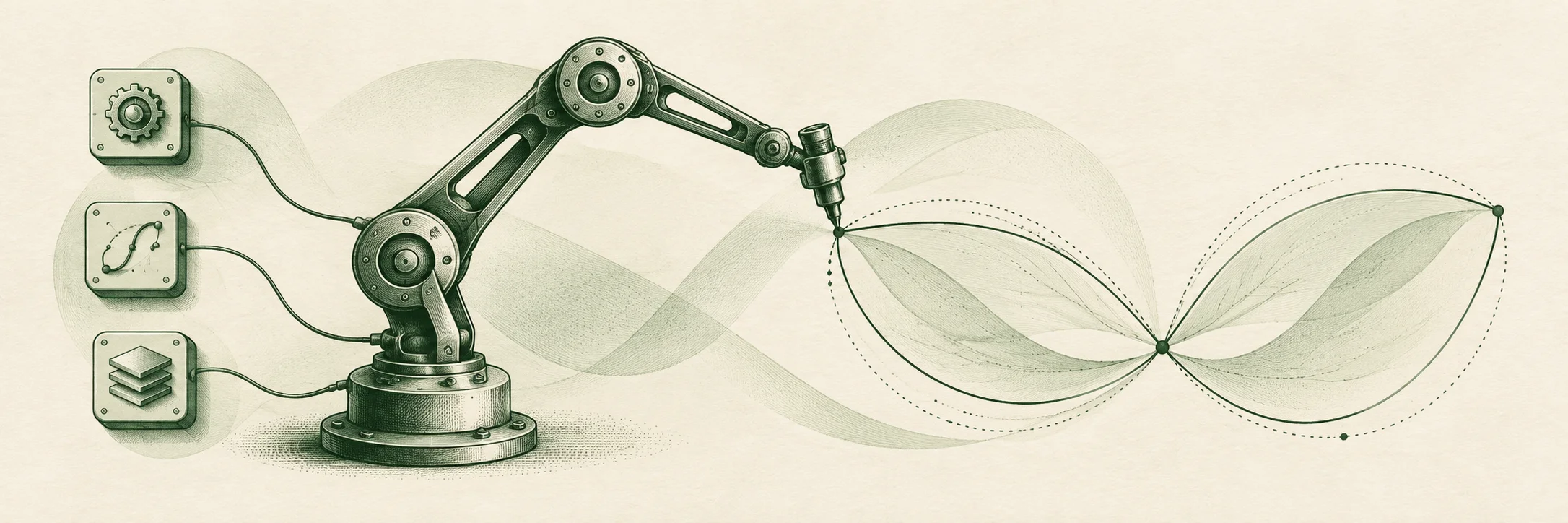
CABRA uses a shared recurrent network—a controller with an internal state that carries information from one moment to the next. A bank of adapters, small neural modules that modify that state, changes how the controller moves. A selection system decides which adapter to activate. The architecture therefore separates a shared control system from the modules that steer it toward different behaviors. 1, Section 3.
The setting is a simulated arm with two links and six muscles. At each step, the controller receives feedback such as hand position and muscle length, then issues muscle commands. This is closed-loop control: the next command depends on what the body actually did. Reproducing a drawing therefore requires coordinating movement through the simulated body's dynamics, rather than simply outputting a list of desired points. 1, Section 3.1.
How the method works
The researchers first train a teacher controller to produce movements. CABRA, the student, sees demonstrations of five complete tasks, including reaches, circles, and figure eights. It is not separately shown the isolated half-movements that will later become useful building blocks. Its encoder reads a demonstration and estimates both where its two segments divide and which adapter should control each segment. Its decoder then tries to reproduce the movement through the arm simulator. 1, Sections 3.1–3.2.
There is guidance in that learning problem. Ten adapter codes are available, with five reserved for the outward phase and five for the return. A training objective also asks the encoder to identify the demonstrated task. The researchers supply a framework for organizing behavior, while leaving the assignment of particular movements to particular adapters to be learned. This distinction explains what the model discovers and what the experimental design makes easier. 1, Section 3.1.2.
Training rewards accurate hand trajectories, with additional terms controlling activity and muscle effort. During the decoder's simulated movement, the movement error updates the adapters and other execution components, but does not directly update the shared recurrent connections. Those connections are trained through the encoder's objectives. This arrangement gives the adapters a specific job: modify the shared controller so it can execute the selected behavior. 1, Section 3.2 and Appendix A.2.
A useful check asks whether the adapter codes actually matter. The researchers force all 25 outward/return code combinations for each training task. If the codes were interchangeable labels, changing them should make little difference. Instead, substituting the outward code substantially worsens tracking, while several return codes can be shared. That intervention supports the interpretation that the modules carry behaviorally meaningful information. 1, Figure 3.
The authors also measure the dimensionality of the adapters' activity: roughly how many independent patterns are needed to describe what each module does. Individual adapters use relatively compact patterns, while their combined activity covers much more of the shared controller's activity space. This is a description of the learned computations, not a measurement of biological brain tissue. It helps explain why a common controller can support distinct movement components. 1, Figure 4 and Appendix A.4.
What the experiments show
The main transfer test constructs a two-petal path from unfamiliar combinations of movement segments. Both CABRA and the teacher are frozen. The researchers then fit a new selection policy, a time-varying strategy for mixing the available controls, for each system. Both receive the same target, optimizer, initialization approach, and 350 optimization steps. This makes the comparison informative about how readily each learned controller can be reused. 1, Figure 6.
CABRA's reported average absolute hand-position error is approximately 0.005 metres, versus 0.04 metres for the teacher: about 5 versus 40 millimetres. On a butterfly-shaped target, after 600 policy updates, the errors are approximately 0.011 and 0.058 metres. Lower error means the simulated hand follows the target more closely. These are results for two constructed targets, rather than an average over a broad collection of unfamiliar tasks. 1, Figures 6–7.
The distinction between a frozen controller and a newly fitted policy is central. CABRA transfers its movement components, but still needs optimization to arrange them for a new target. Its achievement is making that adaptation easier in this setting. The transfer plots do not report variation across independently retrained controllers, so the numerical advantage should be read as a demonstrated result rather than a precise estimate of its typical size. 1, Section 4.4.
Where the research can go next
The study suggests a progression from reusable movements to reusable planning. A natural next experiment, in our reading, is to train a goal-conditioned selector: give it a desired path and ask it to choose adapters without separately optimizing a schedule for that path. Testing it on held-out combinations would reveal whether the library can support rapid adaptation as well as accurate fitted trajectories.
A second direction is to broaden what the modules must handle. Longer sequences, disturbances during movement, and changes to the simulated body would test whether they represent robust control skills or particularly convenient pieces of the original task set. Repeating training would show which module organizations recur. These are proposed extensions of the demonstrated transfer result, not experiments reported in this paper. 1, Sections 4.4–5.
Why it matters
CABRA offers a concrete way to study how learned skills can remain reusable. Its contribution is the connection between an architectural choice, interventions on the learned modules, and improved adaptation to new combinations. The next step is to make selecting those modules as general as the library itself aims to be.
References & paper details
Paper details
- First-public-availability assessment: September 15–16, 2026. The verified v1 submission is September 15; the standard announcement schedule points to that evening in Chicago, and a September 16 discovery record supplies a conservative upper bound. The exact public timestamp was not independently recovered. Both dates satisfy this post's September 11–18 eligibility window. 2
- Repository: arXiv, machine learning, robotics, and computational neuroscience.
- Version analyzed: arXiv:2609.17042v1, dated September 15, 2026, including Appendices A–B.
- Peer review: Preprint, not peer reviewed; no reviewed publication was verified for this version.
- Study type: Computational methods study using closed-loop biomechanical simulation. 1
References
1. Central research paper
Sreejan Kumar, Marcelo G. Mattar, and Lea Duncker. Learning Options for Compositional Motor Control with Adapter Banks. arXiv, v1 dated September 15, 2026. Preprint, not peer reviewed. Version and submission history, full manuscript and appendices, PDF. DOI: 10.48550/arXiv.2609.17042. The manuscript is distributed under CC BY 4.0; this post is an independently written analysis.
2. Publication-timing documentation
arXiv, Availability of submissions, "Announcement Schedule": before-cutoff Tuesday submissions are ordinarily announced Tuesday at 20:00 Eastern, or 19:00 Chicago time. This schedule supports an inference, not an independently logged timestamp. The Fugu-MT discovery record records processing on September 16, 2026; it is used only to bound availability, not as scientific evidence. The primary repository confirms the September 2026 listing and the v1 history in source 1. First release is conservatively reported as September 15–16; no earlier substantive manuscript was found in title-and-author searches.
Get the next breakdown
Subscribe for one email per issue — methods, limits, and what it actually means.
Related breakdowns
October 2026
A New Tool Sorted 2.8 Million Bacterial Gene Clusters Into Families in 17 Hours
Bacteria keep related genes together in groups, and scientists now have millions of them to compare. IGUA groups them quickly by removing duplicates first, then comparing what is left.
Read breakdown →
September 2026
CPP tests selective communication in three-model AI debates
A learned filter chooses which responses language models share during a debate. The study examines how message selection, recipient behavior, and training rewards shape the value of collaboration.
Read breakdown →
September 2026
Frank–Wolfe Decomposition Gives Neural Optimizers Feasible Candidates
A shared training framework turns neural-network scores into valid candidate solutions. Its experiments show where learned combinations help and how solution quality trades off against computation.
Read breakdown →